WHAT FACTORS INFLUENCE THE USE OF BELAJAR.USD LEARNING MANAGEMENT SYSTEMS? AN ANALYSIS OF TAM 3 BASED ON LECTURER’S VIEW
DOI:
https://doi.org/10.24071/icebmr.v3i1.103Keywords:
Intention, Learning Management Systems, Perceived Ease of Use, Perceived Usefulness, Technology Acceptance ModelAbstract
The aim of this research is to explore the factors influenced the use of ‘belajar.usd’ Learning
Management Systems (LMS) from the lecturer’s view according to Technology Acceptance Model 3 (TAM 3). This research is a quantitative research. The data in this research were collected using questionnaire to explore the perception of the respondents.
This research use purposive sampling method. The respondents of this research were 42 lecturers in Economic Faculty, Sanata Dharma University, Yogyakarta, Indonesia. The collected data then was analyzed using Partial Least Square – Structural Equation Modeling (PLS-SEM) technique.
The result shows that behavioral intention on using the belajar.usd Learning Management System did not affect the actual use. More detailed, the determinant of behavioral intention on using LMS is perceived ease of use.
Downloads
References
Al-Gahtani, S. S. (2016). Empirical investigation of e-learning acceptance and assimilation: A structural equation model. Applied Computing and Informatics, 12(1), 27–50. https://doi.org/10.1016/j.aci.2014.09.001
Almulla, M. A. (2024). Investigating Students’ Intention to Use M-Learning: The Mediating Role of Mobile Usefulness and Intention to Use. International Journal of Information and Communication Technology Education, 20(1), 1–26. https://doi.org/10.4018/IJICTE.337136
Ashraf, M., Ahmad, J., Hamyon, A. A., Sheikh, M. R., & Sharif, W. (2020). Effects of postadoption beliefs on customers’ online product recommendation continuous usage: An extended expectation-confirmation model. Cogent Business & Management, 7(1), 1–17. https://doi.org/10.1080/23311975.2020.1735693
Bansak, C., & Starr, M. (2021). Covid-19 shocks to education supply: How 200,000 U.S. households dealt with the sudden shift to distance learning. Review of Economics of the Household, 19(1), 63–90. https://doi.org/10.1007/s11150-020-09540-9
Bhagat, S., & Kim, D. J. (2020). Higher Education Amidst COVID-19: Challenges and Silver Lining. Information Systems Management, 37(4), 366–371. https://doi.org/10.1080/10580530.2020.1824040
Bui, T. T. H., Jambulingam, M., & Amin, M. (2022). A literature review of franchisee performance: Insights for further research. Cogent Business & Management, 9(1). https://doi.org/10.1080/23311975.2022.2044573
Calisir, F., Altin Gumussoy, C., Bayraktaroglu, A. E., & Karaali, D. (2014). Predicting the Intention to Use a Web‐Based Learning System: Perceived Content Quality, Anxiety, Perceived System Quality, Image, and the Technology Acceptance Model. Human Factors and Ergonomics in Manufacturing & Service Industries, 24(5), 515–531. https://doi.org/10.1002/hfm.20548
Camilleri, M. A., & Camilleri, A. C. (2022). The Acceptance of Learning Management Systems and Video Conferencing Technologies: Lessons Learned from COVID-19. Technology, Knowledge and Learning, 27(4), 1311–1333. https://doi.org/10.1007/s10758-021-09561-y
Cheng, M., & Yuen, A. H. K. (2018). Student continuance of learning management system use: A longitudinal exploration. Computers & Education, 120, 241–253. https://doi.org/10.1016/j.compedu.2018.02.004
Davis, F. D. (1989). Perceived usefulness, perceived ease of use, and user acceptance of information technology. MIS Quarterly, 13(3), 319–340.
Davis, F. D., Bagozzi, R. P., & Warshaw, P. R. (1989). User acceptance of computer technology: A comparison of two theoretical models. Management Science, 35(8), 982–1003.
Davoodi, S., Akbarpour, L., & Hadipour, E. (2020). THE EFFECTS OF PSYCHOLOGICAL VARIABLES ON EFL TEACHERS` ATTITUDE TOWARD TECHNOLOGY: CASE STUDY OF IRAN. Information Technologies and Learning Tools, 77(3), 101–113. https://doi.org/10.33407/itlt.v77i3.3622
Esteban-Millat, I., Martínez-López, F. J., Pujol-Jover, M., Gázquez-Abad, J. C., & Alegret, A. (2018). An extension of the technology acceptance model for online learning environments. Interactive Learning Environments, 26(7), 895–910. https://doi.org/10.1080/10494820.2017.1421560
Fishbein, M., & Ajzen, I. (1975). Formation of intentions. In Belief, attitude, intention and behavior: An introduction to theory and research (pp. 288–334). Addison-Wesley Publishing Company.
Fındık-Coşkunçay, D., Alkış, N., & Özkan-Yıldırım, S. (2018). A Structural Model for Students’ Adoption of Learning Management Systems: An Empirical Investigation in the Higher Education Context. Educational Technology & Society, 21(2), 13–27.
Hair, J. F., Jr., Hult, G. T. M., Ringle, C. M., & Sarstedt, M. (2017). A Primer On Partial Least Squares Structural Equation Modeling (PLS-SEM) (2e ed.). SAGE Publications, Inc.
Ismail, M., Celebi, E., & Nadiri, H. (2019). How Student Information System Influence Students’ Trust and Satisfaction Towards the University?: An Empirical Study in a Multicultural Environment. IEEE Access, 7, 111778–111789. https://doi.org/10.1109/ACCESS.2019.2934782
Kraleva, R., Sabani, M., & Kralev, V. (2019). An Analysis of Some Learning Management Systems. International Journal on Advanced Science, Engineering and Information Technology, 9(4), 1190–1198. https://doi.org/10.18517/ijaseit.9.4.9437
Lavidas, K., Papadakis, S., Filippidi, A., Karachristos, C., Misirli, A., Tzavara, A., Komis, V., & Karacapilidis, N. (2023). Predicting the Behavioral Intention of Greek University Faculty Members to Use Moodle. Sustainability, 15(7), 1–12. https://doi.org/10.3390/su15076290
Ma, L., Ali, Z., & Yin, S. (2024). Implementation of Learning Management Systems (LMS) in higher education systems through bipolar complex hesitant fuzzy Aczel-Alsina power aggregation operators: A case review for China. PLOS ONE, 19(4), e0300317. https://doi.org/10.1371/journal.pone.0300317
Nguyen, N.-T. (2021). A study on satisfaction of users towards learning management system at International University – Vietnam National University HCMC. Asia Pacific Management Review, 26(4), 186–196. https://doi.org/10.1016/j.apmrv.2021.02.001
Saari, U. A., Tossavainen, A., Kaipainen, K., & Mäkinen, S. J. (2022). Exploring factors influencing the acceptance of social robots among early adopters and mass market representatives. Robotics and Autonomous Systems, 151, 1–14. https://doi.org/10.1016/j.robot.2022.104033
Saroia, A. I., & Gao, S. (2019). Investigating university students’ intention to use mobile learning management systems in Sweden. Innovations in Education and Teaching International, 56(5), 569–580. https://doi.org/10.1080/14703297.2018.1557068
Sayaf, A. M., Alamri, M. M., Alqahtani, M. A., & Al-Rahmi, W. M. (2021). Information and Communications Technology Used in Higher Education: An Empirical Study on Digital Learning as Sustainability. Sustainability, 13(13), 7074. https://doi.org/10.3390/su13137074
Sorkun, M. F., Yurt, O., & Hsuan, J. (2022). Service modularity in e-learning programs: An analysis from the perceived usefulness perspective. International Journal of Operations & Production Management, 42(5), 637–660. https://doi.org/10.1108/IJOPM-09-2021-0598
Tao, D., Shao, F., Wang, H., Yan, M., & Qu, X. (2020). Integrating usability and social cognitive theories with the technology acceptance model to understand young users’ acceptance of a health information portal. Health Informatics Journal, 26(2), 1347–1362. https://doi.org/10.1177/1460458219879337
Tırpan, E. C., & Bakırtaş, H. (2020). Technology Acceptance Model 3 in Understanding Employee’s Cloud Computing Technology. Global Business Review, 1–20. https://doi.org/10.1177/0972150920957173
Tseng, H. (2020). An exploratory study of students’ perceptions of learning management system utilisation and learning community. Research in Learning Technology, 28, 1-19. https://doi.org/10.25304/rlt.v28.2423
Unal, E., & Uzun, A. M. (2021). Understanding university students’ behavioral intention to use Edmodo through the lens of an extended technology acceptance model. British Journal of Educational Technology, 52(2), 619–637. https://doi.org/10.1111/bjet.13046
Varea, V., González-Calvo, G., & Garcia-Monge, A. (2022). Exploring the changes of physical education in the age of Covid-19. Physical Education and Sport Pedagogy, 27(1), 32–42. https://doi.org/10.1080/17408989.2020.1861233
Venkatesh, V. (2000). Determinants of Perceived Ease of Use: Integrating Control, Intrinsic Motivation, and Emotion into the Technology Acceptance. Information Systems Research, 11(4), 342–365.
Venkatesh, V., & Bala, H. (2008). Technology Acceptance Model 3 and a research agenda on interventions. Desicion Sciences, 39(2), 273–314.
Venkatesh, V., & Davis, F. D. (2000). A theoretical extension of the technology acceptance model: Four longitudinal field studies. Management Science, 46(2), 186–204.
Waris, I., & Hameed, I. (2023). Modeling teachers acceptance of learning management system in higher education during COVID ‐19 pandemic: A developing country perspective. Journal of Public Affairs, 23(1), 1–13. https://doi.org/10.1002/pa.2821
Xie, T., Zheng, L., Liu, G., & Liu, L. (2022). Exploring structural relations among computer self-efficacy, perceived immersion, and intention to use virtual reality training systems. Virtual Reality, 26(4), 1725–1744. https://doi.org/10.1007/s10055-022-00656
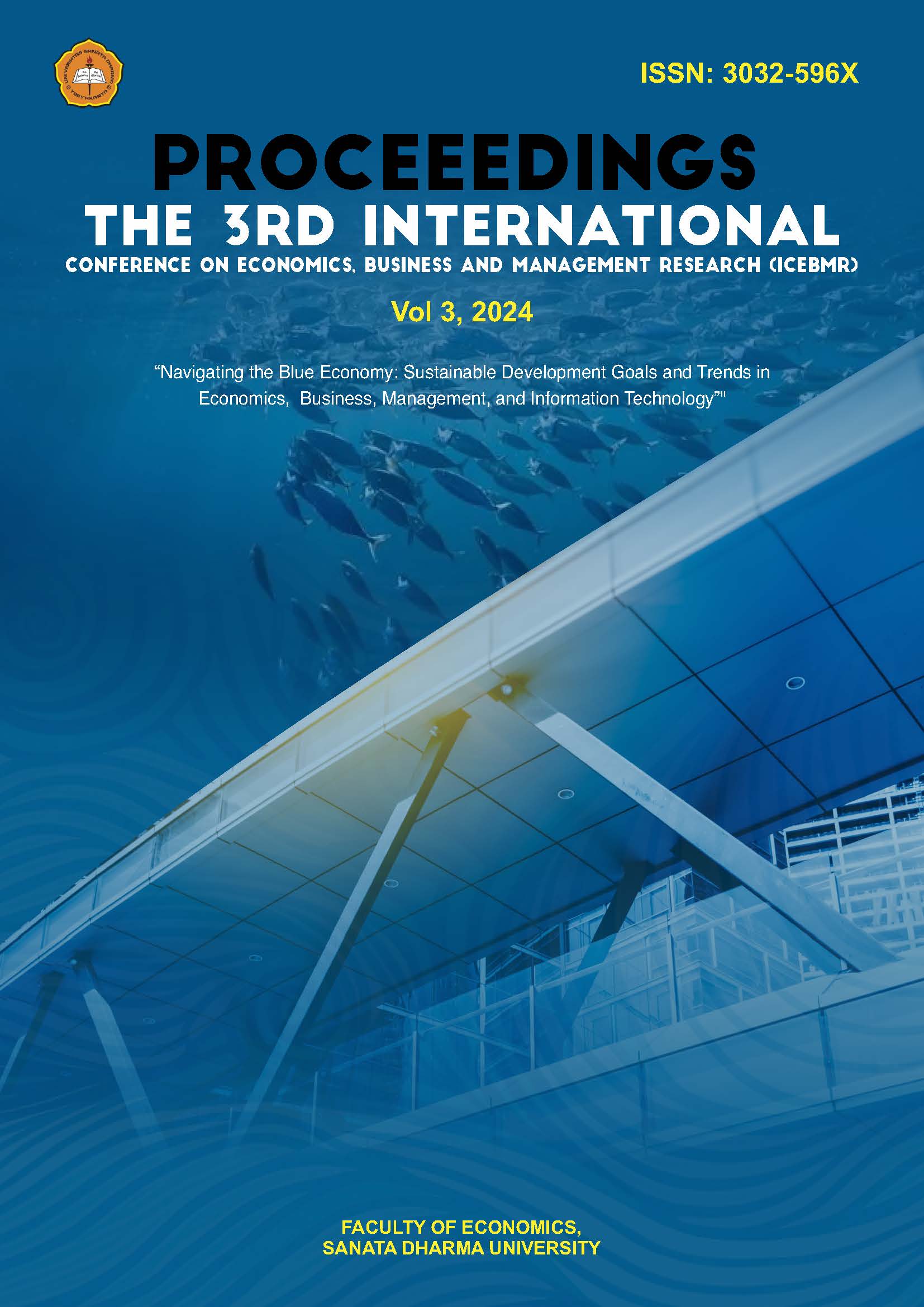
Downloads
Published
Issue
Section
License
Copyright (c) 2024 Ignatius Aryono Putranto (Author)

This work is licensed under a Creative Commons Attribution 4.0 International License.






.png)