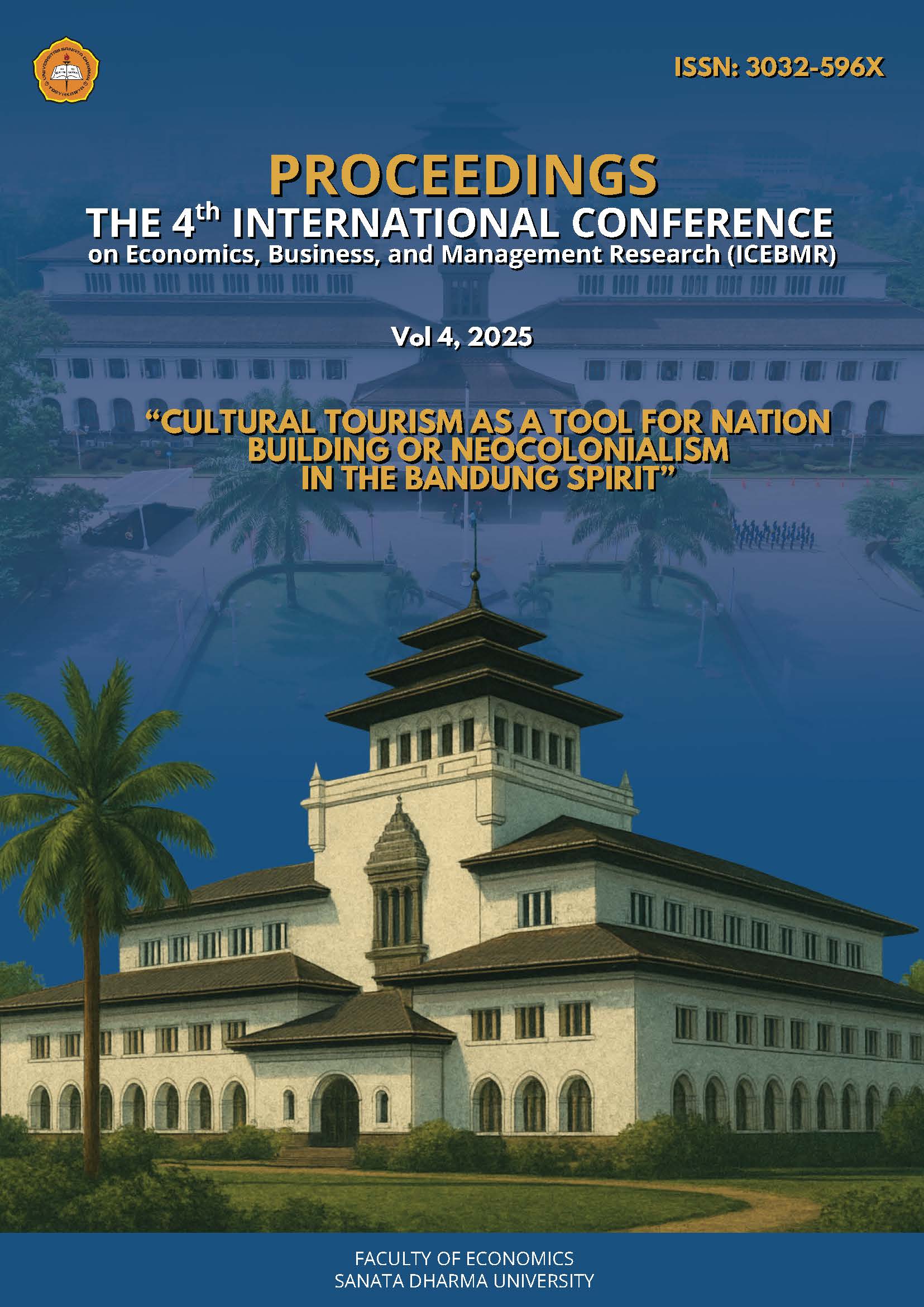
CULTURAL TOURISM AS A TOOL FOR NATION BUILDING OR NEOCONIALISM IN THE BANDUNG SPIRIT
DOI:
https://doi.org/10.24071/icebmr.v4i1.54Keywords:
cultural tourism, nation building, colonialism, civilizations, intangible assets, intellectual propertyAbstract
The final document of the cultural committee at the Bandung Conference emphasized that Asia and Africa is thebirthplace of great civilizations. Modern cultural tourism has helped the world to discover many of their treasures.Colonialism tended to give Asia and African an undeserved inferiority complex. Social science has raised ourconsciousness about the dangers of ethnocentricity and the recognition of multiple intelligences. Unlike rawmaterials and other materials extracted by colonial power, culture is an intangible asset that cannot be stolen.Independence proved to be a necessary but not sufficient condition for the development of the Global South. Muchof it is still materially poor yet culturally rich. Globalization has made these riches more available to bothinternational and domestic tourists. Intellectual property rights now protect these riches. Cultural tourismincludes music, dance, handicraft, dress, architecture, gastronomy, agriculture and religion. Although they can beused for commercial purposes in international tourism, they can also be used by local people to increase theirnational pride and build their nation. This results in a Win-Win situation instead of neocolonialism.
Downloads
References
Adayatma, Timoteus Elian et al.,2025. Bahasa Indonesia as Source of Identity and Cultural Tourism Attraction. Yogyakarta: Sanata Dharma Center for Tourism Research and Development.
Allen, Kelly D. 1992. Heritage Tourism and Urban Development in India. Practicing Anthropology. Vol. 14 No. 2 [Spring], 24-42.
Awaritefe, Onome Daniel. 2004. Tourist values, activities and motivation for travel to Third World Destinations: Case study of Nigeria. Tourism Review. Vol. 59 No. 1, 34-43.
Baroto, Media Putri et. al. 2025. Asia Africa Conference Museum: Cultural Tourism as a Tool for Nation Building in the Bandung Spirit. Yogyakarta: Sanata Dharma Center for Tourism Research and Development.
Britton. S. 1999. Tourism dependency and development: A mode of analysis in Sing Tej Vir, H.L. Theuns and F.M. Go [Eds]. Towards Appropriate Tourism: The Case of Developing Countries. Frankfurt: Peter Lang Veriag, 93-116.
Bystrzanowski, Julian [Ed.]. 1989. Tourism as a Factor of Change: A Sociocultural Study. Vienna: European Coordination Center for Research and Documentation in Social Science.
Cohen, Erik. 1992. Pilgrimage Centers: Concentric and Eccentric. Annals of Tourism Research. Vol. 19 No. 1, 33-50.
Dogan, H. 1989. Forms of adjustment: Sociocultural impacts of tourism. Annals of Tourism Research. Vol. 16, 216-236.
Drucker, Peter. 1969. The Age of Discontinuity. New York: Harper.
Dwi, Lisa Kusuma et al. 2025. Impact of Music Royalties on Cultural Tourism, Sustainability and Local Community Welfare. Yogyakarta: Sanata Dharma Center for Tourism Research and Development.
Fadli Zon, 2025. Why culture still matters in the Global South’s fight for justice. Jakarta Post. May 5, 6.
Gearing, Charles E., William W. Swart and Tungut Var. 1974. Establishing a measure of touristic attractiveness. Journal of Travel Research. Vol. 12 No. 4 [Spring], 1-8.
Graburn, Nelson H.H. 1976. Ethnic and Tourist Arts. Berkeley, CA.: University of California Press. Handayani, Farisma Wahyu et al. 2025. The Role of Traditional Fashion as a Source of Identity in the Development of Cultural Tourism. Yogyakarta: Sanata Dharma Center for Tourism Research and Development
Haviland, William A. 1993. Cultural Anthropology [7th Ed.] Orlando, Fl.: Harcourt, Brace Jovanovich. Hope, Christine, Alan P. Muhlemann and Tamsin L. Potter. 2000. Culture: A critical review and framework for further research in Tourism and Culture: Managing Change. 50th Congress of AIEST [Hangzhou, China]. St. Gallan, Switzerland, 45-67.
Hughes, Howard L. 1989. Tourism and the arts. Tourism Management. Vol. 10 No. 2 [June], 97-99. International Association of Scientific Experts in Tourism. 1984. Tourism and the Architectural
Heritage: Cultural, Legal, Economic and Marketing Aspects. St. Gallen, Switzerland: The Association.
International Union of Official Travel Organizations. 1974. Charter for Development and Protection of Tourism Resources and Influence of Cultural Traditions on the Formation of Distinctive Supply. Geneva, Switzerland: IUOTO.
Jahar, Jafari. 1974. The socio-economic costs of tourism for developing countries. Annals of Tourism Research. Vol. 1 No. 7 [May], 227-262.
Johnson, Barbara R. 1992. Anthropology’s role in stimulating responsible tourism. Practicing Anthropology. Vol. 14 No. 2 [Spring].
Kariam, Anglia Kodi et al. 2025. Traditional Handicraft Gerabah and Hand Weaven Cloth as a Tool for Attracting Tourist. Yogyakarta: Sanata Dharma Center for Tourism Research and Development.
Kluckhohn, Clyde and W.H. Kelly. 1945. The concept of culture in Ralph Linton [Ed.] The Science of Man in the World Crisis. New York: Vintage Books, 78-107.
Kroeber, Alfred L. and Clyde Kluckhohn. 1963. Culture: A Critical Review of Concepts and Definitions.
New York: Vintage Books.
Larkush Mishra. 1999. Cultural Tourism in India. New Delhi: Mahit Publications.
Leba, Elsa Emiria and Nababan, Helena F. 2025. Saatnya Dunia Selatan bergerak Bersama. Kompas. April 21, 4.
Lee, J. 1993. Tourism and Development in the Third World. London: Routledge.
Leheny, D. 1995. A political economy of Asian sex tourism. Annals of Tourism Research. Vol. 17, 367-384.
Lorong, Monika Bura et. al. 2025. Cultural Tourism Based on Coffee Agrotourism: Case Study of Coffee in Kintamani, Bali. Yogyakarta: Sanata Dharma Center for Tourism Research and Development.
McCarthy, Bridget Beattie. 1991. Cultural Tourism: How the Arts Can Help Tourism Products. Portland, Oregon: Bridget Beattie McCarthy.
McIntosh, Robert W., Goeldner, Charles R. and Ritchie, J.R. Brent. 1995. Tourism Principles, Practices and Philosophies [7th Ed.]. New York: Wiley.
McKercher, Bob and Hilary du Cros. 2002. Cultural Tourism: The Partnership between Tourism and Cultural Heritage. New York: The Harworth Hospitality Press.
Muhammad Habib Abiyan Dzamwan and Wang Yuehong. 2025. Keeping the Bandung Spirit alive. China Daily. April 25 – May 1, 25.
Natalegawa, Marty. 2025. The Global South: Challenges, aspirations and the road ahead. Jakarta Post. April 24, 2.
Neta, Teresia Beatrice Devina et. al. 2025. The Role of Religion is Stimulating the Balinese Tourism Economy: A Study of Ritual and Religions Traditions. Yogyakarta: Sanata Dharma Center for Tourism Research and Development.
Ong Tee Keat. 2025. Living up to the Bandung Spirit. Jakarta Post. May 2-6, 23.
Puspita, Olivia Margarereta et al. 2025. Transformation of Village Tourism in Gamplong as a Destination of Creative Tourism in Yogyakarta Through the Outdoor Gamplong Studio Used as a Venue for Indonesia Movie Filming. Yogyakarta: Sanata Dharma Center for Tourism Research and Development.
Rajiv Bhatia. 2025. Bandung Principles, world order and the imperative for change. Jakarta Post. Parts 1 April 23, 6 and Part 2 April 24, 6.
Roeslan Abdulgani, H. 2020. The Bandung Connection: The Asia Africa Conference in Bandung in 1955. Bandung: Museum of the Asian African Conference.
Richie, Brent J.R and Zins, Michel. 1978. Culture as determinant of the attractiveness of a tourism region. Annals of Tourism Research. Vol. V No. 2 [April/ June], 252-267.
Rodenburg, E. 2002. The effects of scale in economic development: Tourism in Bali. Annals of Tourism Research. Vol. 7 No. 2, 177-196.
Rogers, Alisclair. 1992. Peoples and Cultures. New York: Oxford University Press.
Shackley, Myra. 2001. Managing Sacred Sites: Service Provision and Visitor Experience. London: Continuum.
Semangat KAA perlu modernisasi. 2025. Kompas. April 17, 4.
Singh, T. Review of tourism in developing countries. Tourism Recreation Research. Vol. 22 No. 2, 75-76.
Smith, Valene L and Maryann Brent. 2001. Hosts and Quests: Tourism Issues of the 21st Century. Chico, CA: Department of Anthropology California State University.
Spillane, James J. 2005. Tourism in Developing Countries: Neocolonialism or Nation Building. The Fourteenth JRD Tata Oration on Business Ethics in Management and Labour Studies. Vol. 30 No. 1 [February], 7-37.
Tanamal, Yvette. 2025. ’Bandung Spirt’ needed more than ever. Jakarta Post. April 17, 1, 11. Uli, Maretha. 2025. ‘Bandung Spirit’ touted as way forward for Global South. Jakarta Post. April 21, 1,11.
Upadhya, C and Rutten, M. 1994. In search of a comparative framework: Small Scale Entrepreneurs in Asia and Europe in M. Rutten and C. Upadhya [Eds] Small Business Entrepreneurs in Asia and Europe: Toward a Comparative Perspective. New Delhi: Sage Publications, 13-46.
Toops, Stanley. 1993. Xingiang’s Handicraft Industry. Annals of Tourism Research. Vol. 20 No. 1, 88- 106.
Toronata Tambun. 2025. Rediscovering Indonesia’s rhythm: A hope for 2045. Jakarta Post. April 26, 7.
Virdika Rizky Utama. 2025. “Global South” dan ilusi netralitas. Kompas. April 23, 6.
Wantah, Johannes Gelfanandy. 2025. The Borobudur Temple as Driver of the Tourist Economy: An Analysis of Architectural Value and Cultural Heritage. Yogyakarta: Sanata Dharma Center for Tourism Research and Development.
Weiermair, Klaus. 2000. The process of industrialization and globalization of tourism services and its encounter with local service cultures in Tourism and Culture: Managing Change. 50th Congress of AIEST [Hangzhou, China]. St. Gallan, Switzerland, 113-135.
Wirayuda, Ragil Putra et. al. 2025. Investigating Culture Through Gastronomy Tourism in Solo: The Richness of Traditional Food as a Tourism Asset. Yogyakarta: Sanata Dharma Center for Tourism Research and Development.
Young, George. 1973. Cultural Tourism. London: Penguin.
Yuyun Wahyuningrum. 2025. Bandung Spirit and the fight for human rights today. Jakarta Post. April 25, 6.
Zeppel, Heather and C. Michael Hall. 1991. Selling Arts and History: Cultural Heritage and Tourism. Journal of Tourism Studies. Vol. 2 No 1 [May], 29-45.
Downloads
Published
Issue
Section
License
Copyright (c) 2025 James J. Spillane (Author)

This work is licensed under a Creative Commons Attribution 4.0 International License.






.png)